Search trends are changing.
For years, people went to Google with questions such as “How do I fix this?”, “What does this mean?” or “Where can I find this?”
Now, an increasing number of people are searching for something different:
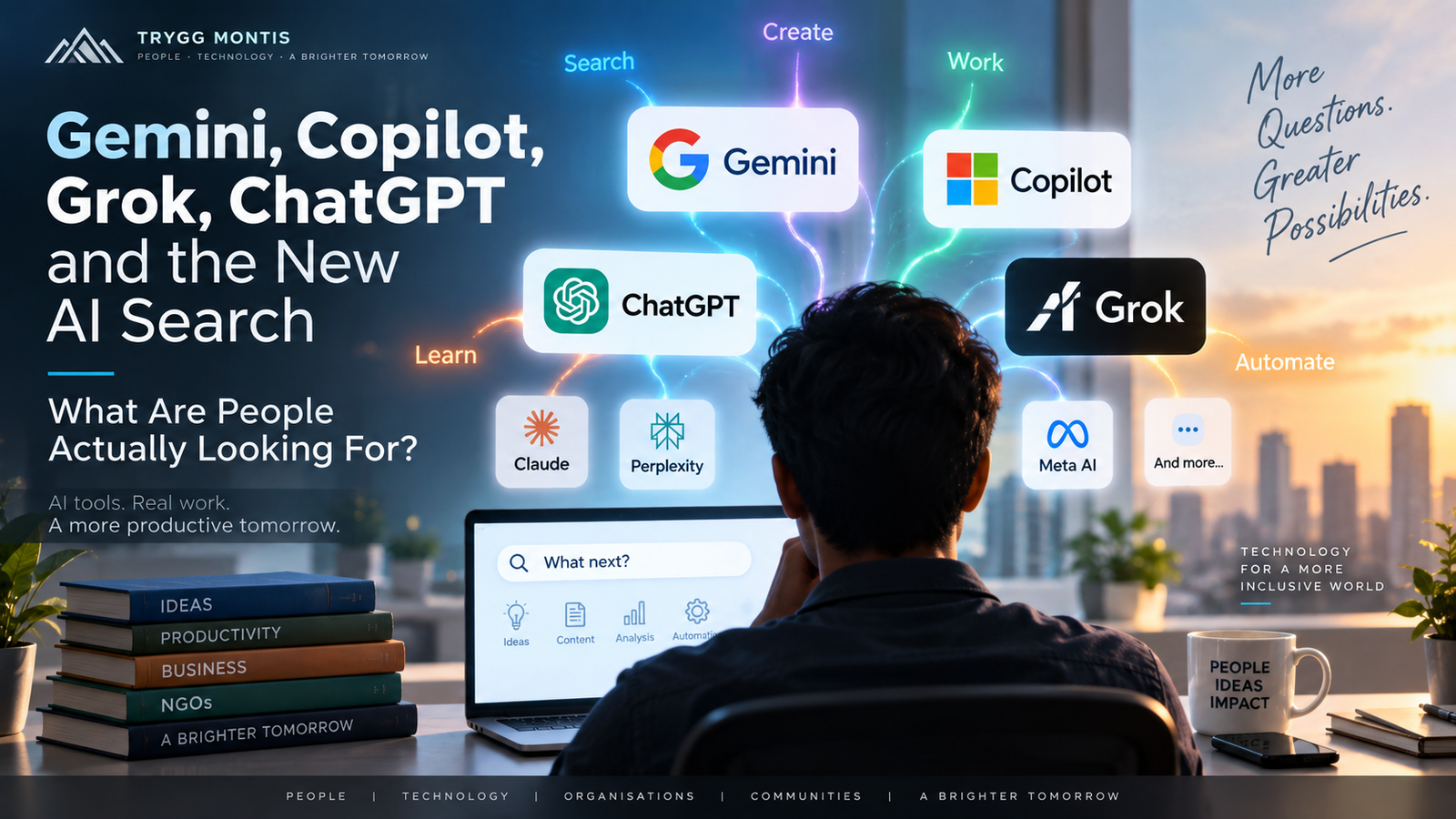
Gemini. Copilot. ChatGPT. Grok. AI bots.
These are not simply search terms. They represent a fundamental change in how people interact with computers and the internet.
At the same time, the AI assistant market has expanded far beyond a single chatbot. ChatGPT, Google Gemini, Microsoft Copilot, Grok, Claude, Perplexity, Meta AI and other platforms are increasingly competing to become the place where people ask questions, create content, analyse information and get work done.
So what is driving this change?
---
1. What Is Trending on Google Right Now?
Google remains one of the world's most important gateways to information. But the things people search for are changing rapidly.
A search trend does not necessarily mean that a technology is universally popular or that everyone is using it. Search trends can be driven by a new product release, a news event, a viral post, a software update or simple curiosity.
Nevertheless, the increasing visibility of AI-related terms is difficult to ignore.
Instead of searching only for information, people are increasingly searching for tools that can process the information for them.
That distinction matters.
Consider two searches:
> “How do I create an Excel formula to calculate monthly attendance?”
versus:
> “AI tool that can analyse my attendance spreadsheet.”
The first search asks Google to find information.
The second asks the internet to help find a tool capable of doing the work.
That is the bigger change happening underneath today's AI boom.
---
2. Gemini: Google's AI Assistant
Google Gemini is Google's family of generative AI models and its AI assistant.
Gemini can be used for writing, brainstorming, learning, summarising information, analysing images and interacting with information from Google's ecosystem. Depending on the account and available features, Gemini can also work with services such as Gmail, Google Drive and other Google products.
Google has also been pushing Gemini beyond the traditional chatbot model.
In 2026, Google introduced Gemini Spark, describing it as a personal AI agent designed to perform tasks proactively rather than simply responding to a question. Google announced its expansion to Google AI Pro subscribers in India, with integrations involving services such as Gmail, Docs and Sheets.
This illustrates an important transition:
> AI is moving from answering questions to performing tasks.
Instead of:
> “How do I organise these emails?”
the expectation increasingly becomes:
> “Organise these emails for me.”
That is a very different model of computing.
---
3. Microsoft Copilot: AI Inside the Workplace
Microsoft Copilot takes a somewhat different route.
Rather than existing only as a standalone chatbot, Copilot is deeply connected to Microsoft's productivity ecosystem.
Microsoft describes Copilot as an AI assistant that can help with brainstorming, writing, coding, searching and repetitive tasks. Copilot capabilities are available across products and services including Microsoft 365, Teams, Outlook and Edge, depending on the version and account.
This makes Copilot particularly relevant to organisations already using Microsoft products.
Imagine a workplace where an employee can ask an AI assistant to:
Summarise a long email thread
Draft a document
Analyse information
Help create a presentation
Find information across workplace data
Assist with repetitive tasks
Generate or explain code
The important point is that the AI is increasingly being placed inside the software people already use.
This is one reason terms such as “Copilot” can suddenly see increased search interest.
People aren't necessarily searching for an abstract AI concept anymore.
They are searching for AI inside the tools they already work with.
---
4. Grok and the Rise of AI Bots
Grok, developed by xAI, represents another direction in the AI race.
Grok is available through the web and mobile applications and supports conversational questions, brainstorming, writing, image and video generation, voice interaction and file analysis.
But one of the more interesting developments is Grok Bot.
In August 2026, xAI announced Grok Bot as a system of AI teammates capable of operating their own computer and working across applications and tools. The idea is that a user can hand an AI agent a task and allow it to work through that task rather than simply returning a text response.
This is where the terminology starts changing.
We have traditionally talked about:
Chatbots
Now we increasingly hear:
AI assistants
And increasingly:
AI agents / AI bots
The difference is important.
A chatbot primarily communicates.
An assistant can help you accomplish a task.
An agent or bot can potentially execute multiple steps on your behalf.
That could eventually mean giving an AI a task such as:
> “Find these five invoices, compare the amounts, prepare a summary and create a report.”
Instead of receiving instructions on how to do it, the user expects the AI to actually perform the workflow.
---
5. ChatGPT Is Part of the Same Bigger Shift
It would be impossible to discuss this transformation without mentioning ChatGPT.
ChatGPT has evolved considerably beyond its original text-chat interface. It can help with everyday tasks including writing, studying, planning, mathematics, coding and analysing images and files. It can also search the web when current information is required.
And ChatGPT is not alone.
Users today can choose from a growing collection of AI platforms, including:
ChatGPT — OpenAI
Gemini — Google
Copilot — Microsoft
Grok — xAI
Claude — Anthropic
Perplexity — AI-powered search and research
Meta AI — Meta
DeepSeek
Mistral
Character.AI
Canva's AI tools
Numerous specialised coding, writing, design and research platforms
The result is an increasingly competitive AI ecosystem.
There is no longer simply “AI.”
There are now different AI products optimised for different workflows.
---
6. So Which AI Should You Use?
This is where things become more interesting.
There isn't necessarily one AI assistant that is the right choice for everyone.
The better question is:
> What are you trying to accomplish?
For example:
| Requirement | Platforms worth considering |
|---|---|
| General-purpose AI assistance | ChatGPT, Gemini, Claude |
| Google Workspace workflows | Gemini |
| Microsoft 365 workflows | Copilot |
| Conversational research | ChatGPT, Gemini, Claude, Perplexity |
| AI-powered search | Perplexity, ChatGPT, Gemini and others |
| Coding | ChatGPT, Claude, Gemini, Copilot and specialised coding tools |
| Image generation | ChatGPT, Gemini and specialised image platforms |
| Social/content creation | ChatGPT, Canva and other specialised tools |
| AI agents and task automation | Platforms increasingly offering agent/bot capabilities |
| Organisation-specific automation | Custom AI + APIs + automation platforms |
Capabilities, pricing, integrations and availability change rapidly, so today's comparison should not be treated as permanent.
The important lesson is not to ask:
> “Which AI is the best?”
Instead ask:
> “Which AI fits the way I work?”
---
7. AI Is Changing the Meaning of Search
This may be the most important change of all.
For decades, search engines primarily helped users find information.
Generative AI can help users understand, transform and act on information.
Imagine searching:
> “Annual leave policy.”
Traditional search might provide links to websites and documents.
An AI assistant might instead answer:
> “Here is the relevant section of the policy, summarised in five points.”
The next step could be:
> “Now draft an email to the employee explaining it.”
And eventually:
> “Send the approved email.”
The search box is gradually becoming something closer to a digital work interface.
This does not mean traditional search is disappearing. Google Search remains enormously important.
Instead, the two approaches are increasingly converging.
Search finds. AI interprets. Automation acts.
That combination could become one of the defining characteristics of workplace technology over the next few years.
---
8. What Does This Mean for Businesses and NGOs?
For small businesses, NGOs and other organisations, the AI discussion should not simply be about buying an AI subscription.
The bigger question is:
> Where is your organisation wasting human time?
Consider a typical organisation.
Every month, employees may spend hours:
Preparing reports
Cleaning spreadsheets
Writing emails
Summarising meetings
Preparing proposals
Formatting documents
Searching through files
Creating presentations
Entering data
Preparing attendance reports
Answering repetitive questions
Reviewing documents
Moving information between systems
Many of these activities contain repetitive steps.
That makes them potential candidates for AI assistance or automation.
For example:
Before AI
`Google Form → Spreadsheet → Manual cleaning → Manual report → Email → Filing`
With AI and automation
`Google Form → Structured data → Automated processing → AI-assisted analysis → Report → Notification → Archive`
The technology doesn't necessarily replace the employee.
It can remove some of the repetitive work surrounding the employee.
That distinction is particularly important for smaller organisations that may not have large IT teams.
---
9. The AI Opportunity for NGOs
NGOs have an especially interesting opportunity.
Many organisations operate with limited budgets but large amounts of information.
They may have:
Beneficiary records
Attendance data
Programme reports
Monitoring and evaluation data
Donor requirements
Financial documents
Medical records
Training records
Surveys
Photographs
Project documentation
AI can potentially assist with classification, summarisation, drafting, data analysis, document processing and workflow automation.
But this comes with an equally important responsibility.
Sensitive information should not simply be copied into whichever public AI chatbot happens to be available.
Organisations need to think about:
Data privacy
Access controls
Consent
Retention
Confidentiality
Vendor policies
Human review
Accuracy
Auditability
AI adoption should therefore be treated as an IT governance issue, not merely a productivity experiment.
---
10. What Should Small Businesses Pay Attention To?
Small businesses don't necessarily need to build their own AI model.
They need to understand how AI can fit into the systems they already use.
For example:
Website + AI
An AI assistant can help answer common customer questions.
Google Workspace + AI
AI can help with documents, spreadsheets, email and information retrieval.
Microsoft 365 + Copilot
AI can work alongside Word, Excel, Outlook, Teams and other Microsoft services.
CRM + AI
AI can assist with customer summaries, follow-ups and sales documentation.
Accounting + AI
AI can help classify or explain financial information, subject to appropriate controls and professional review.
Internal Operations + AI
AI can help turn forms, spreadsheets and databases into reports and workflow triggers.
The most useful AI implementation may not be a flashy chatbot on the front page of a website.
It may be a small automation that saves an employee 30 minutes every day.
Over a year, that becomes hundreds of hours.
---
11. The Bigger Picture: AI Is Becoming a Workplace Tool
The biggest story behind today's AI search trends isn't really Gemini versus Copilot versus ChatGPT versus Grok.
It is the fact that AI is becoming part of normal computing.
Just as people stopped thinking about the internet as a special technology and started treating it as infrastructure, AI is moving in the same direction.
It is appearing in:
Search engines
Office applications
Smartphones
Browsers
Coding environments
Design software
Customer service
Education
Business software
Data analysis
Communication tools
Automation platforms
The next phase is likely to be less about asking:
> “Can AI do this?”
and more about:
> “Which parts of our work should AI handle?”
That is a much more practical question.
And for businesses, NGOs and individuals, it is the question worth exploring.
---
Final Thoughts
The appearance of terms such as Gemini, Copilot, ChatGPT and Grok in search conversations reflects something larger than a collection of competing AI products.
People are learning a new way of interacting with technology.
Instead of navigating through menus, searching through documents and manually completing every step, users are increasingly able to describe what they want and let software help work out the process.
The technology is still evolving rapidly. Features change, models improve, new competitors appear and today's limitations can become tomorrow's standard functionality.
For organisations, however, one lesson is already clear:
> AI adoption is no longer just about experimenting with chatbots. It is about redesigning how work gets done.
At Trygg Montis, this is the part of AI that interests us most — not AI as a buzzword, but AI as a practical technology for improving websites, data systems, business processes, reporting and everyday organisational work.
The future of AI may not be one giant chatbot replacing everything.
It may be hundreds of small AI capabilities quietly helping people get their work done.
And that future is already arriving.